What size whole-house water filter do you need? The answer depends less on a simple bedroom or bathroom count than on how much water your household uses simultaneously, what you want to treat, and whether a system is compatible with your plumbing and installation conditions.
A properly selected system should support the household’s expected demand while using treatment components suited to the water source and treatment goal. This guide explains the information to gather before comparing systems. It does not replace a review of current product specifications or advice from a qualified water-treatment professional.
What Whole House Water Filter Sizing Means
Whole-house water filter sizing is the process of matching a system to the home’s water demand, treatment objectives, and installation conditions. It is not just the physical height or diameter of a filter housing.
A useful sizing review considers three questions:
- Demand: How much water may be used at one time?
- Treatment: What water-quality concern or treatment goal must the system address?
- Compatibility: Can the system operate with the home’s plumbing, pressure, space, and utility conditions?
Household size can be a starting clue, but two homes with the same number of people may have very different demands. A home with overlapping showers, laundry, dishwashing, or irrigation can place a different load on a system than a home where those uses rarely occur together.
Start With the Water Source and Treatment Goal
Before estimating flow, identify the water source and the reason for treatment. Municipal water and private well water can present different concerns, and no single filter media or system configuration addresses every possible issue.
Record the following information:
- Water source: municipal supply, private well, or another source.
- Primary concern, such as a verified contaminant, taste or odor concern, sediment, or another documented treatment objective.
- Available water-test results and the date of the test, when testing is relevant.
- Any existing treatment equipment, such as a softener, a sediment filter, or a disinfection component.
- Whether the goal is filtration, conditioning, disinfection, or a combination of treatment steps.
Use only product pages and manufacturer documentation that explicitly support the intended application. A sizing match does not establish contaminant-removal performance.
Estimate Peak Household Demand
Peak household demand is the combined water use that may occur during the busiest realistic period in the home. Sizing around a daily average can miss the short periods when several fixtures or appliances operate together.
List simultaneous water uses.
Think through a typical high-demand period and identify which uses can overlap, such as:
- Showers, including multiple showerheads or body sprays.
- Bathtubs or other high-demand fixtures.
- Bathroom and kitchen faucets.
- Laundry equipment and dishwashers.
- Toilets, utility sinks, and other indoor uses.
- Irrigation or outdoor water use, if it passes through the treatment system.
Use verified flow information for the actual fixtures and appliances whenever possible. Do not rely on a universal allowance for a bathroom, bedroom, or resident without confirming that the method applies to the home.
Build a realistic demand scenario.
Choose the most likely combination, not an impossible scenario in which every outlet runs at once. For example, a household might plan around two showers and laundry operating together, while another may need to account for a large tub or outdoor use. Document the assumptions so H2O can review them.
Household Demand Worksheet
Complete this worksheet using verified fixture or appliance flow information. Add rows as needed.
| Fixture or use | Likely simultaneous quantity | Verified flow per unit | Source or notes |
|---|---|---|---|
| Shower(s) | |||
| Bathtub or specialty fixture | |||
| Bathroom or kitchen faucet(s) | |||
| Laundry or dishwasher | |||
| Irrigation or outdoor use | |||
| Other |
Understand Flow Ratings Before Comparing Systems
Flow is commonly expressed in gallons per minute (GPM). Product literature may describe service flow, peak flow, or other operating limits. These terms are not interchangeable unless the manufacturer defines them that way.
When reviewing a product, confirm which rating is relevant to the household-demand calculation, what operating conditions apply to that rating, and whether the published specification reflects the complete system rather than a single component.
Also, review any documented relationship among flow, pressure loss, treatment performance, and component life. A higher numerical flow rating does not automatically make a system the correct choice if the treatment media, configuration, or installation requirements do not match the application.
Check Plumbing and Installation Compatibility
A system that appears suitable by flow still needs an installation review. Compare the home’s conditions with those in the current product page, installation manual, and manufacturer documentation.
Confirm at least the following:
- Main water-line size and the system’s inlet and outlet connection sizes.
- Available operating pressure and any documented pressure limitations.
- Available installation space, service clearance, and orientation requirements.
- Drain access, electrical service, or other utilities required by the selected system.
- Location conditions, bypass arrangement, and access for future service.
- Any installation requirements in the applicable manual and local plumbing rules.
Review H2O’s whole-house installation information as an introduction, then use the documentation for the exact system under consideration.
Account for Backwashing and Non-Backwashing Sizing Factors
Backwashing and non-backwashing whole-house systems can have different operating and installation considerations. Keep the household-demand calculation in view, then confirm the requirements for the system type.
Backwashing systems
A backwashing system periodically runs a cleaning cycle for its media. The selected model may require suitable drainage, electrical service, and water supply conditions for that cycle. Verify every requirement in the current manual and product documentation.
Non-backwashing or inline systems
A non-backwashing or inline system does not use the same backwash cycle, but it still must match household demand and may require access for cartridge or media service. Confirm connection sizes, supported flow rates, pressure conditions, and replacement requirements for the exact configuration.
For category-level comparison, review H2O’s backwashing carbon filters and non-backwashing or inline carbon filters.
Use Water Quality to Narrow the System Type
Flow determines how much water the system must handle; it does not determine which treatment method is appropriate. Use verified water-quality information and the treatment goal to narrow the system type, media, or treatment stages.
Before selecting a system, confirm:
- The issue has been identified accurately, including testing where appropriate.
- The manufacturer supports the intended application and water conditions.
- The published performance claim applies to the exact model or component being considered.
- Any pretreatment, post-treatment, or maintenance conditions are understood.
Do not choose a system solely because its name contains “whole house,” “carbon,” “high flow,” or another broad descriptor. Those labels do not establish compatibility or performance for a specific home.
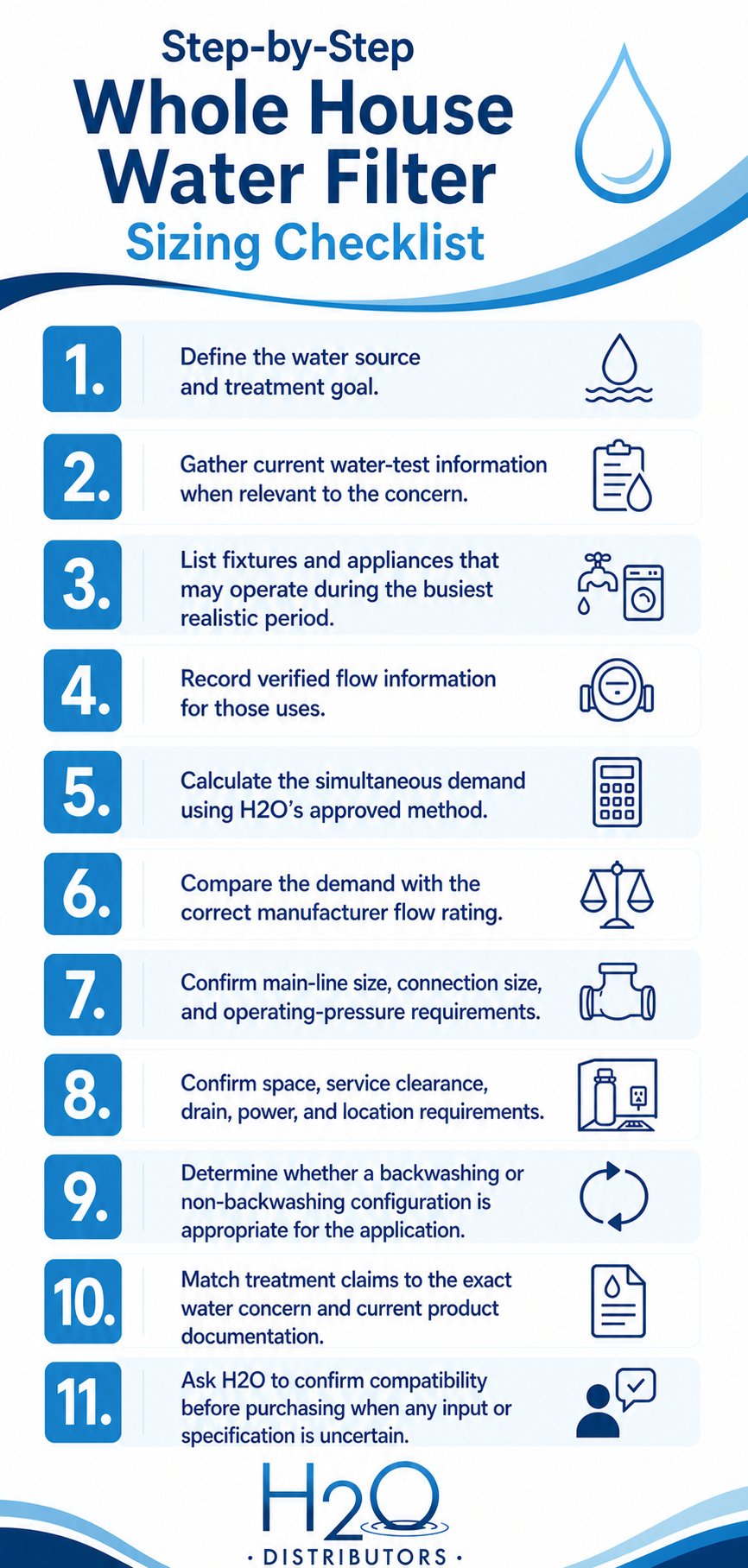
When to Contact a Certified Water Specialist
Contact H2O before selecting a system if the water issue is not clearly identified, the home has unusual fixtures or demand, the available pressure or plumbing details are uncertain, or multiple treatment stages may be needed. Have the worksheet, water source, available test results, and installation details ready for review.
Compare Whole House Systems
Once demand, treatment goals, and installation conditions are documented, browse H2O’s Whole House Water Filter Systems. Use the category page as the product selection destination, then verify the current specifications for any system under consideration.
Need help confirming the fit? Contact H2O Distributors and share the completed sizing worksheet and available water information before purchasing.
Frequently Asked Questions
What size whole-house water filter do I need?
Start with the busiest realistic combination of fixtures and appliances, calculate demand using verified flow information, and compare it with the applicable manufacturer rating. Then confirm the treatment goal, plumbing, pressure, and installation requirements. Household size alone is not enough to select a system.
Can I size a whole-house water filter by the number of bathrooms?
Bathroom count can help identify potential demand, but it does not indicate which fixtures will operate together or account for specialty fixtures, appliances, or outdoor use. Use actual water-use patterns and verified fixture information.
What is the difference between service flow and peak flow?
Manufacturers may use these terms for different operating conditions. Confirm the definition in the documentation for the exact product and ask H2O which rating should be used for selection.
Does water pressure affect whole-house filter selection?
Pressure is part of the compatibility review. Confirm the home’s available pressure, the system’s documented limits, and any published pressure-loss information for the expected flow.
Does a backwashing filter need a drain and power?
Requirements vary by system. Many backwashing configurations use a drain and a powered control, but the current manual for the exact model governs. Confirm the installation requirements before purchase.


